



By Daniel Bates and Peter Geoghegan
A crypto exchange co-founded by Ben Delo, the billionaire behind a record £36 million donation to Reform UK, is accused in a recently filed US lawsuit of systematically trading against its own customers and allegedly keeping Bitcoin that should have been returned to them.
Speaking to Democracy for Sale, Daniel Charest, a US-based lawyer representing clients in a class action against BitMEX filed in New York in July, said he believed the exchange’s conduct was “illegal, unethical and immoral”.
The case names Delo as a defendant alongside BitMEX co-founders Arthur Hayes and Samuel Reed, and seeks the return of nearly 623 Bitcoin, worth about $40 million at today’s prices.
BitMEX’s chief executive, Peter Wilkinson, said that “since 2020, BitMEX has faced and successfully defended over 20 spurious claims, including 12 in the United States” and the company “looks forward to vigorously defending itself against this latest set of spurious and opportunistic claims.”
Delo’s £36 million pledge to Nigel Farage’s party, announced in September, is the largest political donation on record in Britain. Fellow crypto billionaire Christopher Harborne followed with a donation of the same size. In all, Reform has now received more than £100 million from the two men.
Farage has pledged to back deregulation of the crypto industry. Delo has said he is not supporting Reform for personal gain. “I love my country - that’s why I want a level democratic playing field and a party that’s ready to govern,” he said when the donation was announced.
“Fraudulent conduct”
In 2022, Delo pleaded guilty to one count of violating the Bank Secrecy Act, for failing to establish an anti-money laundering programme at BitMEX. He was pardoned by Donald Trump in March 2025, along with Hayes, Reed and the company.
The July class action was brought on behalf of an investor, David Namdar, and a Nevada-incorporated company called BKX Services. At its heart is BitMEX’s “insurance fund”.
In essence, the way BitMEX worked was to let customers bet on the price of Bitcoin with heavily borrowed money, at up to 100 times their own stake. When the market moved against a trader, the exchange automatically closed, or “liquidated”, their position. If the exchange got a better price than it needed to cover the trader’s losses, the surplus did not go back to the customer. It went into the insurance fund, a pot of Bitcoin the exchange said protected traders when positions went bad.
According to the complaint, BitMEX liquidated customers’ positions while they still held far more than enough to cover them, seizing collateral “still worth nearly twice the losses incurred”. Rather than handing back the difference, the exchange allegedly kept it.
“These liquidations resulted in the seizure - theft - of Bitcoin that rightfully belongs to Plaintiffs and members of the Class,” the lawsuit states.
BitMEX’s own exchange rules stated that customers had “no rights or interest” in the insurance fund.
The complaint also alleges that BitMEX ran an “Insider Trading Desk” with “God access” to customers’ positions and liquidation points, information traders believed was private. The desk allegedly used “burner” trading accounts, with generic email addresses, to pass as ordinary customers on the exchange.
The class action’s stated aim is “to recover in-kind the property BitMEX converted and to hold Defendants accountable for the fraudulent conduct that made that conversion possible.”

In an exclusive interview, the plaintiffs’ lawyer, Charest, told us that BitMEX customers thought they were trading on an open market, when in reality the company was “playing an active role against their clients”.
The lawyer said his clients were experienced crypto investors who knew it could be a “rough-and-tumble” arena, with terms and conditions that could be unfavourable to traders.
“We looked at the terms and conditions and we didn’t proceed unless we thought we had arguments we could win,” he said.
But even taking that into account, he claimed, there was “something illegal, unethical and immoral” about the conduct alleged in the complaint.
“If you’re trading against your customers and manoeuvring the price points … in order to take money from your customers, there’s no other word for it,” he said. “It cannot be legal, it’s certainly not moral and they should be made to pay.”
Whatever the contracts said, Charest argued, “there are still protections afforded to people to avoid fraudulent, nakedly rapacious behaviour.”
Lawyers for Delo and BitMEX have filed a motion to dismiss the case, arguing the claims are time-barred and fail to make out a claim of fraud.
“Come at me bro”
BitMEX’s insurance fund swelled during the market crash of 12 March 2020, known as “Black Thursday”, and eventually held almost 38,000 Bitcoin. According to figures given to Democracy for Sale by Thomas Braziel, a bankruptcy expert, around $3 billion worth of Bitcoin was withdrawn from BitMEX in November 2025, leaving about 3,600 Bitcoin, worth around $230 million, in the company’s accounts.
Charest said he could not say where the money had gone.
BitMEX stopped trading on 23 September, after announcing in July that it would close following a “strategic review”. Customers can still withdraw their funds.
Charest’s lawsuit is not the only recent claim alleging improper liquidations. A claim, filed in a New York bankruptcy court on 12 September by the estate of Celsius, a crypto lender that collapsed in 2022, alleges that Celsius’s holdings on BitMEX were needlessly wiped out through a similar liquidation process, and seeks around $495 million worth of Bitcoin.
The class action is not the first time Delo’s conduct at BitMEX has been challenged in court. Democracy for Sale has reviewed earlier cases against BitMEX, including a claim alleging racketeering and fraud brought by Anatoly Sorokin, who dropped his lawsuit in January 2022.
Sorokin’s complaint referred to a meme allegedly sent by Delo to Elfio Guido Capone, an early investor in BitMEX who had asked about the status of his investment. According to court papers, the meme showed a grinning man with the words: “Incorporated in Seychelles. Come at me bro”.
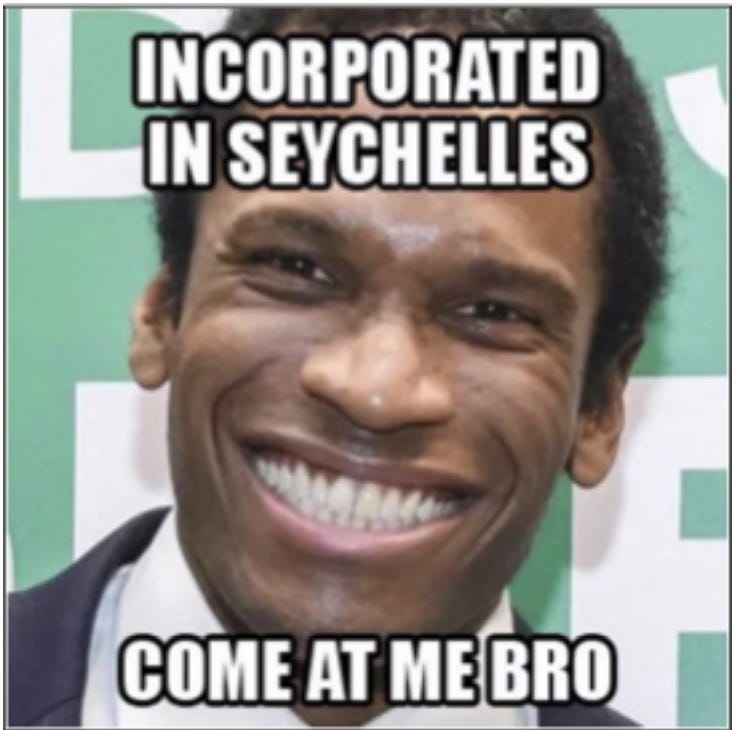
Meme allegedly sent by Ben Delo to BitMEX investor (source: court documents)
BitMEX was incorporated in the Seychelles but also had offices in Hong Kong and the US. Sorokin’s lawsuit claimed the meme was “cynically suggesting that BitMEX could dodge its legal obligations to its own investors simply by using a shell company incorporated in the Seychelles to defeat personal jurisdiction of the United States courts”.
Guido Capone and another early investor, Frank Amato, filed a $540 million fraud lawsuit against BitMEX in California in 2019. It was dismissed the following year, after reportedly being settled.
Guido Capone did not respond to messages through one of his investment companies.
Reform’s £44m man
Ben Delo did not respond to questions from Democracy for Sale, but in a statement Peter Wilkinson, CEO of BitMEX, said: “Since 2020, BitMEX has faced and successfully defended over 20 spurious claims, including 12 in the United States, which have been based on essentially the same allegations that underpin the cases brought by Celsius and by David Namdar and BKX Services.
“BitMEX looks forward to vigorously defending itself against this latest set of spurious and opportunistic claims.”
Ben Delo is one of the biggest donors in British political history. He gave Reform £8m earlier this year. Announcing his blockbuster £36m donation to Nigel Farage’s party in September, he wrote in the Telegraph that as “a retired veteran of the FinTech industry, I’m accustomed to intense scrutiny and hard knocks.”
BitMEX has since closed. But Delo’s record donation is why these allegations matter far beyond the crypto industry: Reform has received an unprecedented sum from a man who made his fortune in an industry the party has pledged to deregulate.
At Democracy for Sale we’re dedicated to uncovering dark money and hidden influence wherever we find it.
We’re working on major new investigations and chasing down leads. If you don’t already, please become a paid subscriber - for £50 a year you can help us do even more.
If Reform Farage has backers like Ben Delo giving him money then it’s a sure bet it’s not for nothing. The fact that the little dicktator in the US also is in the Bitcoin club and is against regulation too shouldn’t surprise anyone. Our Temu trump Farage likes all these little tricks he’s learning at the trump school of grift.
This sort of research is so important. What awful people. How America is dragging down our expectations and normalising corrupt practices. There’s a real question around how to return to a climate of integrity - but meanwhile it’s vital that we understand better what is currently being subverted.