


By Daniel Bates and Peter Geoghegan
Reform is widely tipped to perform strongly in next week’s elections. Nigel Farage’s party is tapping into rising anger with the political establishment - but it’s also tapped into a rich seam of political funding.
Among the party’s biggest donors is Ben Delo. Until a few weeks ago, most people in British politics had never heard of the Hong Kong-based cryptocurrency billionaire who recently gave £4 million to Reform - and has promised to move back to Britain to avoid Labour’s new cap on donors abroad.
Much of the coverage of Delo’s funding mentioned that he had been pardoned by Donald Trump after he was convicted for failing to implement adequate anti-money laundering checks on his crypto derivatives platform BitMEX.
Delo has said that the US conviction was a “blip” and a “non-crime”. His lawyers have threatened social media accounts publishing information about his offence.
So nothing to see here? Well, Democracy for Sale decided to take a closer look at Delo’s US conviction - and found a story that doesn’t exactly match the light dismissals.
The facts of Delo’s case are clear. In 2022, Delo, who is reputedly Britain’s youngest self-made billionaire was given 30 months probation and a fine of $10 million (£7.3 million).
Delo pled guilty, along with three others, to a violation of the US Bank Secrecy Act by willfully failing to establish, implement, and maintain an anti-money laundering (“AML”) program at BitMEX between 2014 and 2020.
In official court records, submitted for the purpose of his sentencing hearing, US prosecutors described Delo as a “leader of a criminal enterprise” and accused him of telling Iranians they could trade on BitMEX even though it could have breached US sanctions.
In the pre-sentence memo, the prosecutors said Delo had shown a “deep disrespect for the rule of law” and called for him to be placed under house arrest for six months because of the gravity of his conduct.
According to a transcript of the hearing in New York, District Judge John Koeltl told Delo that his crimes were “very serious” and that he “willfully caused his company to violate” US corporate law.
Delo did not respond to repeated requests for comment on this article. During the court case, his lawyers said Delo was guilty of “a compliance failure, a criminal compliance failure, because the systems to keep the US users off the platform didn’t work adequately enough”.
At sentencing Delo said that he made a “terrible decision” and that his sentence of 30 months of probation reflected a “fair resolution” of the case against him.
Recently, however, Reform’s new mega-donor has been noticeably less contrite about his brush with US law enforcement.
“The most successful crypto exchange”
In March 2025, Trump pardoned Delo and the other founders of BitMEX. The US president has issued a slew of pardons for cryptocurrency tycoons.
After his pardon, Delo went on the attack. “A legal wrong has been righted today”, Delo said in a statement.
“As the most successful crypto exchange of its kind,” Delo said, “we were wrongfully made to serve as an example, sacrificed for political reasons and used to send inconsistent regulatory signals”.
Delo added that he “should never have been charged with a criminal offence through an obscure, antiquated law”.
But the Bank Secrecy Act, the law Delo was convicted under, has been on the books since 1970. It’s hardly “obscure” either. It’s been described as “a cornerstone US law aimed at combatting financial crime.”
The court documents in Delo’s case do not give the full breadth of the evidence against him as it didn’t go to trial. The pre-sentencing memo prepared by the prosecution does however, give new insight into his role in BitMEX, where he was chief operations officer and later chief strategy officer, and why he was charged.
In their memo filed ahead of Delo’s sentencing, prosecutors said that he was a “leader in BitMEX’s criminal failure to comply with the BSA (Bank Secrecy Act)”.
Prosecutors alleged that BitMEX allowed US customers to use the platform, even though they should have been prevented from doing so.
In 2015 after a change in US regulation of cryptocurrency, BitMEX said it was withdrawing from the US market but insufficiently rigorous checks allowed Americans to remain on the platform.
Prosecutors claimed that more than $200 million (£148 million) of suspicious transactions ran across the whole of BitMEX’s platform during 2015 and 2020.
Prosecutors also said Delo owned 30 percent of BitMEX and personally made hundreds of millions of dollars from its operations as BitMEX became one of the world’s biggest crypto derivatives platforms.
Delo “thumbed his nose at the law”, prosecutors said, calling for a sentence of six months of home confinement “because of the seriousness of the offense”.
During sentencing, Delo’s lawyer Patrick Smith argued that Farage’s new donor took “numerous steps” to deal with the issue of US users on the BitMEX platform and cited “hundreds and hundreds” of customer support tickets where Delo personally restricted Americans from using their accounts.
Smith said that Delo had “consistently cooperated” with the US Department of Justice including coming to the US voluntarily to give statements and that his client’s role was making sure the trading engine worked and developed the code, rather than setting the compliance policies.
Iranian sanctions
Among the most serious claims against Delo was that he personally told Iranians they could trade on BitMEX even though it could have breached US sanctions.
According to another pre-sentence memo, in January 2017 Arthur Hayes, another executive at the company, who was also charged, and Delo “both told Iranian customers that they were free to trade”.
As a result of these failures, internal BitMEX reports show the company earned money from customers in Iran until at least April 2018.
The court documents stated: “Delo understood as late as November 2018 that the company did not have ‘strict enforcement of US sanctions against Iran etc.,’ and sometimes ‘let these people slip through the cracks’.”
In their submission to the court ahead of sentencing, Delo’s lawyers disputed the claim BitMEX was a hub for illegal activity and said that was an “outdated view of cryptocurrency as inherently nefarious”.
Smith said: “That a handful of potential criminals had accounts on BitMEX does not demonstrate that BitMEX was a haven for criminal activity or that Ben or BitMEX encouraged or enabled laundering of criminal proceeds”.
During sentencing, Delo took full responsibility for his crimes, a sharp contrast to his later tone.
He said he “did not act quickly enough or effectively enough” to ensure BitMEX wasn’t serving US customers. “It was a terrible decision, the consequences of which I have to carry the rest of my life.”
Delo thanked the prosecutors and said that he understood they “have a job to do and work very hard”.
“And ultimately the plea agreement reflects a fair resolution of the BSA charge against me,” he said.
In other court filings and legal arguments, Delo’s lawyers pleaded for leniency and said that his record as a philanthropist was proof he was fundamentally a good person who had overcome adversity.
Delo has signed on to the Giving Pledge, the initiative started by Microsoft founder Bill Gates and investor Warren Buffett to encourage the wealthy to give away their money.
According to reports, Delo has already donated £100 million to charity.
In March 2024 BitMex as a company, pleaded guilty to violating the Bank Secrecy Act for, as prosecutors put it in a press release, “willfully failing to establish, implement, and maintain an adequate anti-money laundering program”.
Damian Williams, who was then the top federal prosecutor in New York, said that BitMEX “opened itself up as a vehicle for large-scale money laundering and sanctions evasion schemes, posing a serious threat to the integrity of the financial system”.
In January last year, BitMex was sentenced to a fine of $100 million and two years of probation.
Then US Attorney Matthew Podolsky said in a press release that the laws that BitMEX breached were essential to “prevent the financing of terrorist activity”.
Two months later, Delo was given a pardon by Trump, as was HDR Global Trading, the entity which controls BitMex. It was reportedly the first time in US legal history that a corporation has received a pardon.
The crypto party
Delo is the latest cryptocurrency billionaire to put his money behind Reform.
Christopher Harborne, a Thai-based businessman and one of the largest shareholders in Tether, has given more than £20 million, including £12 million in the last year - and reportedly an undeclared £5 m to Farage personally ahead of the 2024 general election.
Like Trump, Farage has become a vocal supporter of cryptocurrency. The Reform leader has batted aside warnings from financial crime experts that crypto can be used to facilitate money laundering and illicit activity and said he was considering legal action over Labour’s introduction of a moratorium on crypto donations.
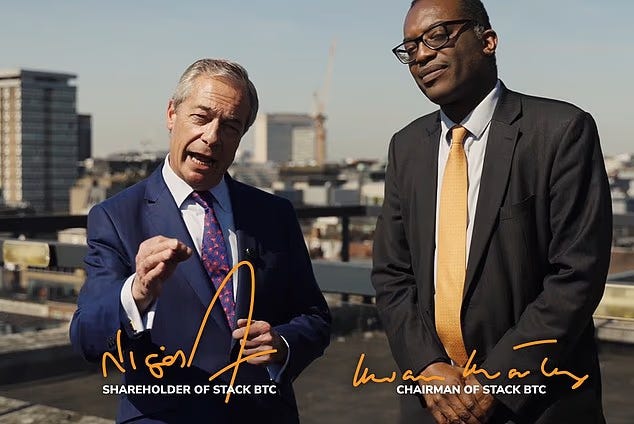
Farage has skin in the crypto game, too. Earlier this year, the Reform leader announced that he had invested £215,000 in a crypto business chaired by former Conservative chancellor Kwasi Kwarteng.
Farage even appeared in a promotional video for Stack BTC, prompting calls from the Lib Dems for the Financial Conduct Authority to investigate whether his actions amount to “attempted interference in the cryptocurrency market” or “attempted market abuse.”
In a press release, Farage said that he had “long been one of the UK’s few political advocates for Bitcoin, recognising the role digital currencies will play in the future of business and finance.”
Bitcoin - the elite populists now have their own currency
Look if tRump says it's okay to pardon criminals then who are law abiding citizens to complain. Oh yeah he's not our PM! He's Nigel's PM though. If those idiots voting Reform don't get it yet then they are in for a rude awakening! They want Britain for the "British" they claim, I wonder how they'll feel when rich "yanks" own everything?!!